
Article by Simone Catania
AI Named Your Startup. Can You Actually Get the Domain?
Aug 17 • 11 min read
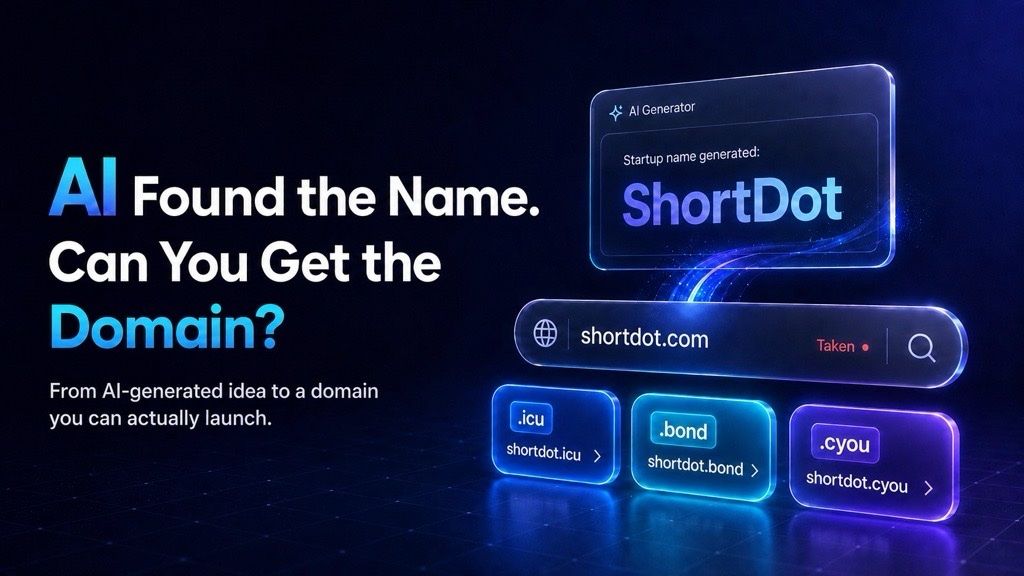
AI Named Your Startup. Can You Actually Get the Domain?
Article by Simone Catania, Global Content & Communications Manager, InterNetX
You describe your idea to an AI, and thirty seconds later you have a name. Not just one. A whole list of them, each with a tidy tagline and a confident little story about why it "captures your brand essence." One of them is perfect. You can already picture the logo.
Then you go to register the .com. And it's gone. Snapped up years ago by someone who never built anything on it and now wants $40,000 to hand it over.
If you've tried to launch anything in the last year, you know this exact feeling. AI has made naming a business almost effortless. At the same time, it made the gap between a great name and an available domain wider than ever. This article is about closing that gap: how to go from an AI-generated name to a domain you can actually register, launch on, and build a real brand around.
Let's get into it.
The naming boom no one warned you about
Building online used to be slow. You'd sketch an idea, wireframe it, hire a developer, and wait weeks to see something live. Now people describe an app in a single prompt and watch AI build and deploy it the same afternoon. The practice that's come to be called vibe coding. More ideas are turning into live projects, and more founders are racing to scale a startup that existed only as a prompt a week earlier. Every one of them needs a name, and a web address.
The data backs this up. In the Global Domain Report 2026, AI-generated brand names ranked as the second-biggest driver of new domain demand in 2025, cited by 40% of respondents, behind only "new businesses" itself. Meanwhile, the global namespace hit a new all-time high of 386.9 million registered domains.
Put simply: AI isn't just helping people name companies. It's reshaping domains' role in the AI-driven web and, more immediately, flooding the domain market with demand. Which brings us to the problem.
Why the perfect .com is (almost) always gone
Here's what a quick naming session won't always surface: the .com you want is probably taken. With around 161 million of them already among the most frequently registered domain names on the internet, the short, clean, brandable ones ran out a long time ago. The domain industry has matured over four decades, and the most obvious strings were claimed well before AI started generating names by the thousand.
So where does AI fit in? If you brainstorm names with a general-purpose chatbot, it's drawing on language patterns, not querying a live registry, so a name that sounds available often isn't. Dedicated AI naming tools are closing that gap: many now check domain and social-handle availability as they generate, and several nudge you straight toward shorter, newer extensions the moment your first pick turns up taken. Either way, you land on the same question: Which name can you actually claim across the web?
Because that's the real shift. AI has made generating names almost trivial; the harder, more valuable work is turning a name into a coherent digital brand that lines up across your domain, your social handles, and every other place people meet you online. Here's how to get there.
How to Turn an AI Name Into a Real Brand
Make the AI work with reality, not against it
Don't just ask for "cool startup names." Ask for names that are likely to be brandable and registrable: invented words, two short real words joined together, or names designed to pair with a specific domain ending. The more constraints you give the model up front, the fewer dead ends you'll hit later.
Check availability before you fall in love
Run every shortlisted name through a domain search before you get attached to any single one. Do it early, do it for the whole list at once, and treat "is the domain available?" as part of the name itself, not an afterthought you deal with at launch. A name you can't register as your domain is not your perfect name.
Look past .com, and match the ending to your idea
This is where most people leave value on the table. A domain ending is real estate you can actually use to say something. Instead of bolting "get," "try," or "hq" onto a name that's already taken (northbeamhq never ages well), pick an extension that fits what you're building:
- A fintech, advisory, or personal brand that trades on trust -> .bond
- A creator, community, or social product -> .icu (yes, it reads as "I see you") or .cyou ("see you")
- A deals, coupons, or e-commerce play -> .qpon
- A launch that needs attention and word-of-mouth -> .buzz
- Something short and endlessly brandable -> .sbs or .cfd
Use the extension as part of the name
The best short domains read as a single idea across the dot. "watch.icu," "join.cyou," "grab.qpon," "make.buzz". The ending does half the branding work for you. AI is great at this once you ask for it: prompt for names that "complete" a phrase using the domain extension, and you'll often land on something more memorable than the generic fallback you'd otherwise settle for.
Sanity-check it with human eyes
Before you commit, read the full domain out loud and then look at it as one unbroken string with no dot. AI won't catch the accidental hidden word, the awkward spelling, or the fact that your clever name is unpronounceable on a podcast. A fresh pair of human eyes still beats the model here, every time.
Secure the edges
Once you've chosen, grab the matching social handles and a defensive variant or two. Consistency between your domain and your handles is one of the simplest ways to build credibility from the first click, and locking down the edges stops someone else from riding on your launch.
Why New gTLDs Are Having a Moment
If "just use a new gTLD" still sounds too vague, the numbers should put you at ease. New gTLDs were the fastest-growing part of the domain market in 2025, up nearly 30% YoY. They outpaced by far the market's overall 2.2% growth, and a fresh batch of new extensions reached general availability that year, widening the menu even further. It's a big part of where the domain industry is heading as AI reshapes discovery and the next gTLD round approaches. And meaning-rich, brandable strings are exactly where the momentum sits.
For example, .sbs and .bond, now rank among the ten most-registered new gTLDs in the world. This isn't a fringe experiment anymore; more founders and investors treat a well-chosen new gTLD as a smart, long-term play rather than a compromise.
In the Global Domain Report 2026, ShortDot's VP of Marketing, Eshan Pancholi, predicts that well-positioned new gTLDs will keep growing as users look beyond .com "for meaning, availability, and relevance." A short new extension delivers all three at once: a name that's actually available, an ending that means something, and, because domains now act as strong trust anchors even on the AI-mediated web, a brand that stands on its own rather than a workaround for a name someone else got to first.
Own the Name, Not Just the Idea
AI has rewritten the rules of naming. It will hand you a hundred great names in a minute, but it won't tell you which ones you can own, and it won't nudge you past the .com reflex that leaves so many founders stuck. That last mile, from a name you love to a domain you can build on, is now the part that matters most.
The good news? It's the easy part, once you know where to look. Let the AI do the brainstorming. Check availability early. And when your first choice is gone, as it almost always is, remember that your perfect domain might be waiting on the other side of a different dot.