
Article by Burkhard Berger
How to Use OKR for Startups Without Overcomplicating It
Sep 16 • 23 min read
A lot of startups overbuild their goals while trying to look organized. They set OKRs that belong inside massive companies. And then everything starts competing with everything else. Good OKRs for startups do the opposite. They create the focus that stops the team from being dragged in 5 directions at once while pretending everything is equally urgent.
And that is exactly what we will help you get right. We will show you how to use OKRs in your startup without turning them into another thing you have to manage. You will also see the 3 best OKR software that stay useful as your startup grows.
What Are OKRs In Startup Context?
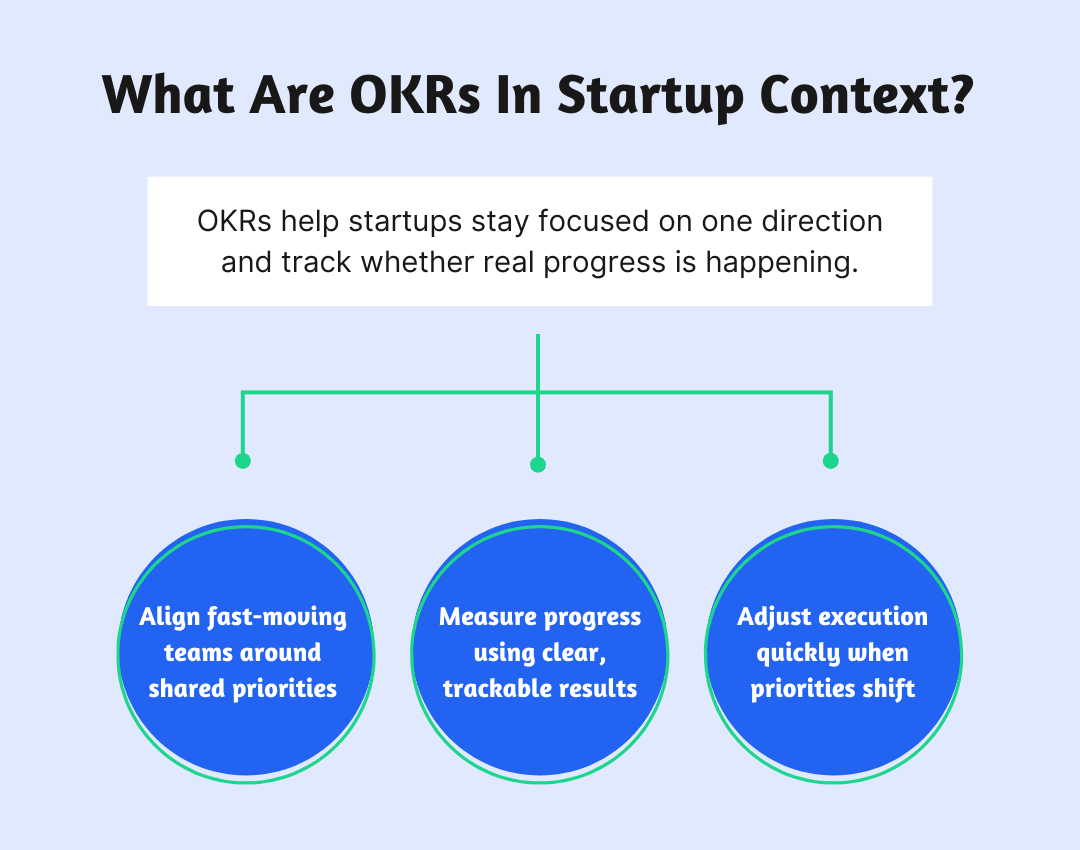
OKRs stand for Objectives and Key Results. They are a simple goal-setting system that helps a startup decide what it wants to achieve and how it will measure progress.
An Objective is the outcome you want to reach. It is specific and time-bound and focuses on direction – not tasks. A Key Result is how you measure whether that objective is actually being achieved. It is always measurable and based on data, not opinions.
In startups, the OKR framework is used to:
- Set clear priorities across small, fast-moving teams
- Keep everyone focused on the same outcomes
- Track progress with numbers instead of assumptions
- Adjust direction quickly based on results
What Strategic Value Do OKRs Bring For Startups: 4 Key Benefits
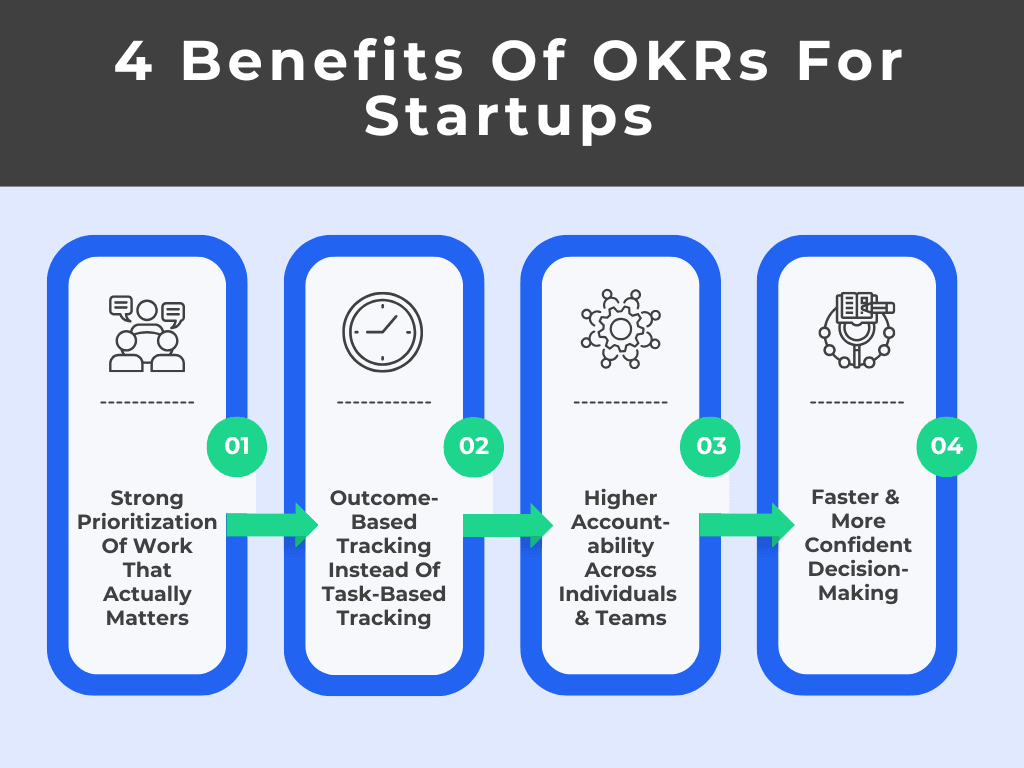
Here are 4 benefits that show exactly where OKR implementation starts making a noticeable difference for startups.
1. Strong Prioritization Of Work That Actually Matters
Startups lose ridiculous amounts of time to work that is important in the moment but changes nothing strategically.
A founder asks for a dashboard redesign. Sales wants three new one-pagers. Someone suggests launching on another platform. Individually, none of these requests is unreasonable. Together, they completely fracture execution.
OKRs help startups stop operating like that. When quarterly goals are painfully clear, teams get much better at saying, “That can wait.” Not because the idea is bad… just because it is not the thing that moves the company forward right now.
That is the real value. OKR methodology reduces strategic drift. Startups can put real force behind one or two priorities that actually affect growth or whatever the company urgently needs most.
2. Outcome-Based Tracking Instead Of Task-Based Tracking
Without OKRs, startups celebrate completion instead of impact. A feature ships. A campaign launches. A sales sequence gets built. Everyone feels productive. Then three months later, activation rates are unchanged, and churn is still terrible.
OKRs force a much more uncomfortable question: Did this actually improve anything? And that changes team behavior fast. Product teams stop adding features just because customers requested them loudly. Marketing stops obsessing over impressions that never convert. Customer success stops measuring activity volume and starts looking at retention movement.
The focus shifts from “we did the work” to “the metric moved.” And that is where startups become smarter operators. Because once outcomes become visible, weak execution becomes visible too.
3. Higher Accountability Across Individuals & Teams
One thing that slows startups down is unclear ownership. A launch gets delayed, or customer complaints pile up, and now nobody fully owns the issue. OKRs remove a lot of that ambiguity because every major priority has someone directly responsible for moving it forward. Not “the other team.” An actual owner.
That changes behavior fast. Weekly team syncs become sharper because people know exactly what they are accountable for.
Teams also become more reliable cross-functionally. Marketing can’t blame the product for missed conversion targets if dependencies were already documented upfront. The product can’t claim they didn’t know retention was a company priority. Everyone sees the same goals in the same place.
4. Faster & More Confident Decision-Making
One thing people don’t always notice with OKRs is how much quicker everyday decisions become. Startups operate in constant uncertainty. And new opportunities appear every week: a partnership request, a custom enterprise feature, a new market, a potential hire, a rebrand idea. Without strategic clarity, every option becomes equally urgent.
OKRs create a filter. If the current company objective is improving retention, every decision naturally starts getting checked against that. And team members can easily tell if something actually helps the goal or distracts from it.
That removes a huge amount of hesitation and internal push-pull. And for startups, speed matters more than perfection… most of the time. The faster a company can make aligned decisions, the faster it can learn and adjust.
How To Use OKR For Startups Without Slowing Down Execution: 6 Proven Strategies
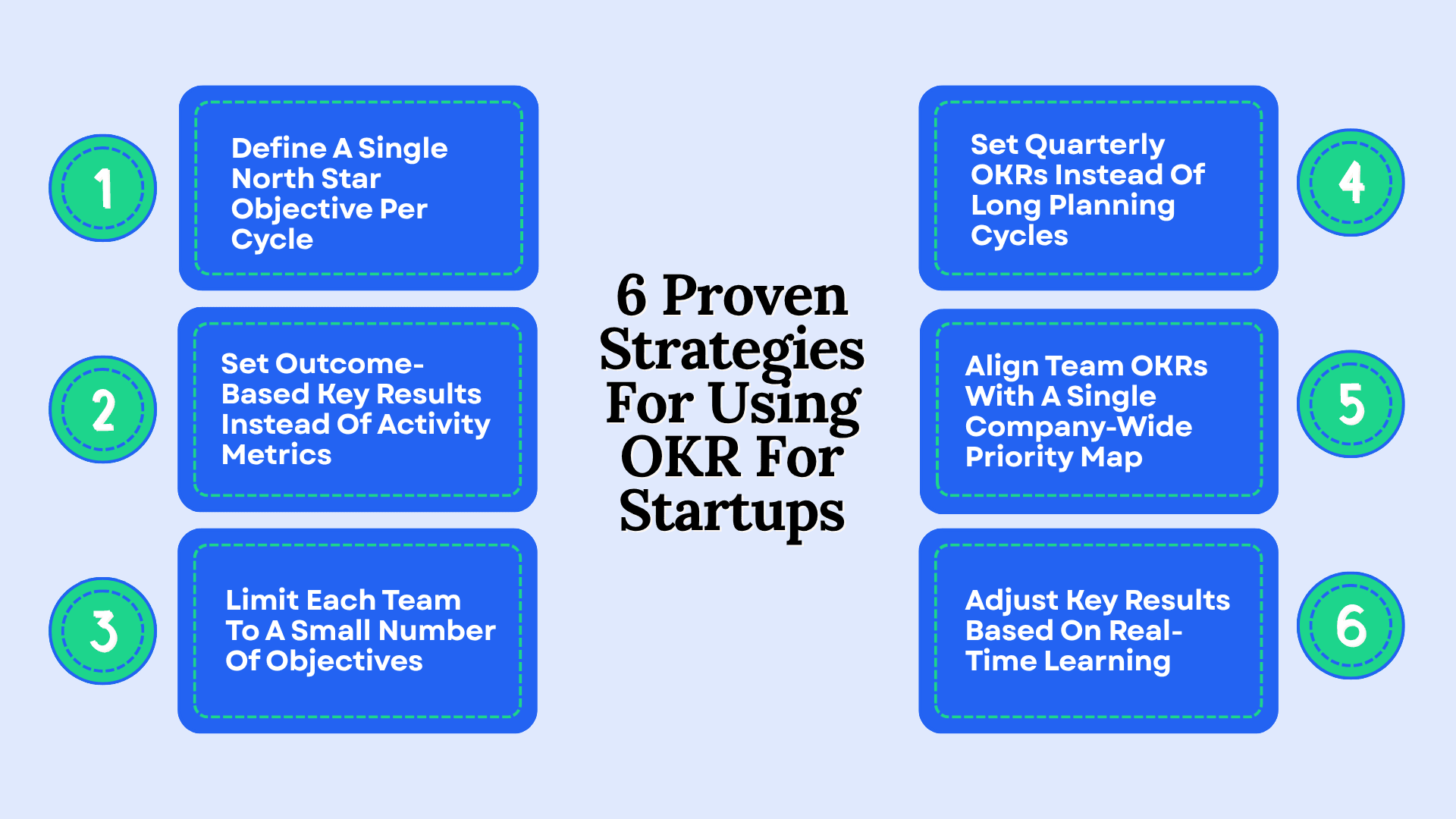
OKRs only work in startups when they stay close to execution. Here’s how to actually implement OKRs in a way that keeps speed intact while still bringing real focus.
1. Define A Single North Star Objective Per Cycle
A lot of startups destroy execution speed by running too many “top priorities” at the same time. Growth matters. Retention matters. Hiring matters. Product velocity matters. Now the company has six “top priorities,” which usually means nobody knows what should actually win when tradeoffs appear.
A single North Star objective gives the company one dominant focus for the next quarter – the thing leadership wants teams thinking about. That clarity lets startups move quickly, and without a central objective, teams naturally drift toward whatever shows up strongest that week.
Do This:
- Pick one measurable business problem that hurts the most right now – not the one that sounds most impressive.
- Write the objective like a decision, not a slogan (something you can use to reject work instantly).
- Ban “second priority objectives” at the company level during the cycle.
- In leadership meetings, run each new idea through one simple question: Does this support the North Star or compete with it?
2. Set Outcome-Based Key Results Instead Of Activity Metrics
Most OKRs fail because they track effort instead of change. Teams end up measuring “emails sent” or “features shipped,” which looks productive but doesn’t tell you if they had an impact.
Outcome-based key results fix this by forcing a simple question: Did customer behavior or monthly recurring revenue actually change? If the answer is no, it didn’t really succeed, no matter how busy the team was.
This also changes how teams design business operations. They stop starting with what we can build and start with what needs to change for users.
Do This:
- Write key results that can be completed without affecting a user-facing or revenue-facing metric.
- Force each KR to answer: “What will behave differently in the market if we succeed?”
- Avoid internal metrics like “number of features shipped” unless tied to adoption or usage change.
- Lock at least one “lagging metric” KR per objective (revenue, retention, activation).
3. Limit Each Team To A Small Number Of Focused Company Objectives
Overload is a quiet execution killer in startups. When every team has 6–8 objectives, nothing really gets finished properly. Work gets split everywhere. Context switching increases. Everything moves slower than expected.
Limiting objectives drives focus to become visible in daily work. When teams only have a couple of real targets, they naturally make better decisions without waiting for approvals or clarification. It also reduces internal confusion. Fewer priorities = fewer “urgent” Slack messages and fewer emergency reshuffles mid-sprint.
Do This:
- Hard cap team-level OKRs, so no team has more than 2 objectives that matter in the cycle.
- Explicitly label “non-priority work” instead of pretending everything is important.
- Remove or defer initiatives that need different success metrics than the main objective.
- Bring the conversation back to the one thing during planning that the team can’t afford to miss.
4. Set Quarterly OKRs Instead Of Long Planning Cycles
Long planning cycles sound mature, but in startups, they become fiction by month two. Markets move. Users behave differently than expected. Assumptions break faster than documentation can be updated.
Quarterly OKRs work because they match reality: startups learn fast, so OKR planning should reset fast too. The benefit here is psychological pressure. A 90-day window pushes teams in a way annual plans never do.
Do This:
- Design OKR program such that meaningful progress must happen within 12 weeks – not “sometime this year.”
- Replace annual roadmaps with rolling quarterly recalibration.
- Keep planning sessions extremely short to avoid over-engineering direction.
- At the end of each quarter, delete assumptions that didn’t survive reality instead of carrying them forward.
5. Align Team OKRs With A Single Company-Wide Priority Map
The biggest slowdown in scaling startups is misalignment. Sales push volume, product pushes usability, support pushes stability, and nobody is wrong, but the system becomes fragmented.
A priority map shows how each team’s success connects to the same end result. It removes the illusion that teams can succeed independently. In reality, they either move together or stall together.
Do This:
- Draw a single-page map showing how each team contributes to the main company outcome.
- Explicitly connect every team's individual OKR to another team’s input or output.
- Use shared metrics where possible rather than isolated departmental dashboards.
- Review alignment in one joint session instead of separate departmental planning.
6. Adjust Key Results Based On Real-Time Learning
Startups never get their assumptions right on the first try. Channels change performance. Product decisions reveal new opportunities mid-quarter. That creates fake progress.
A better approach is controlled flexibility. Keep the objective stable, but let key results evolve when evidence clearly shows the original direction was wrong. If OKRs stay rigid, execution slows – not because people aren’t executing, but because they are executing in the wrong direction.
Do This:
- Change key results only when real user or market data invalidates the original assumption.
- Separate “we executed poorly” from “we aimed at the wrong thing” before adjusting anything.
- Introduce a monthly reality-check team meeting focused only on whether assumptions still hold.
- Document every change to key results along with the data that triggered it.
3 Companies That Used OKRs So Well That Startups Still Study Their Approach
The next OKR examples show how these 3 brands applied them and why early-stage companies still keep learning from them.
1. Brondell
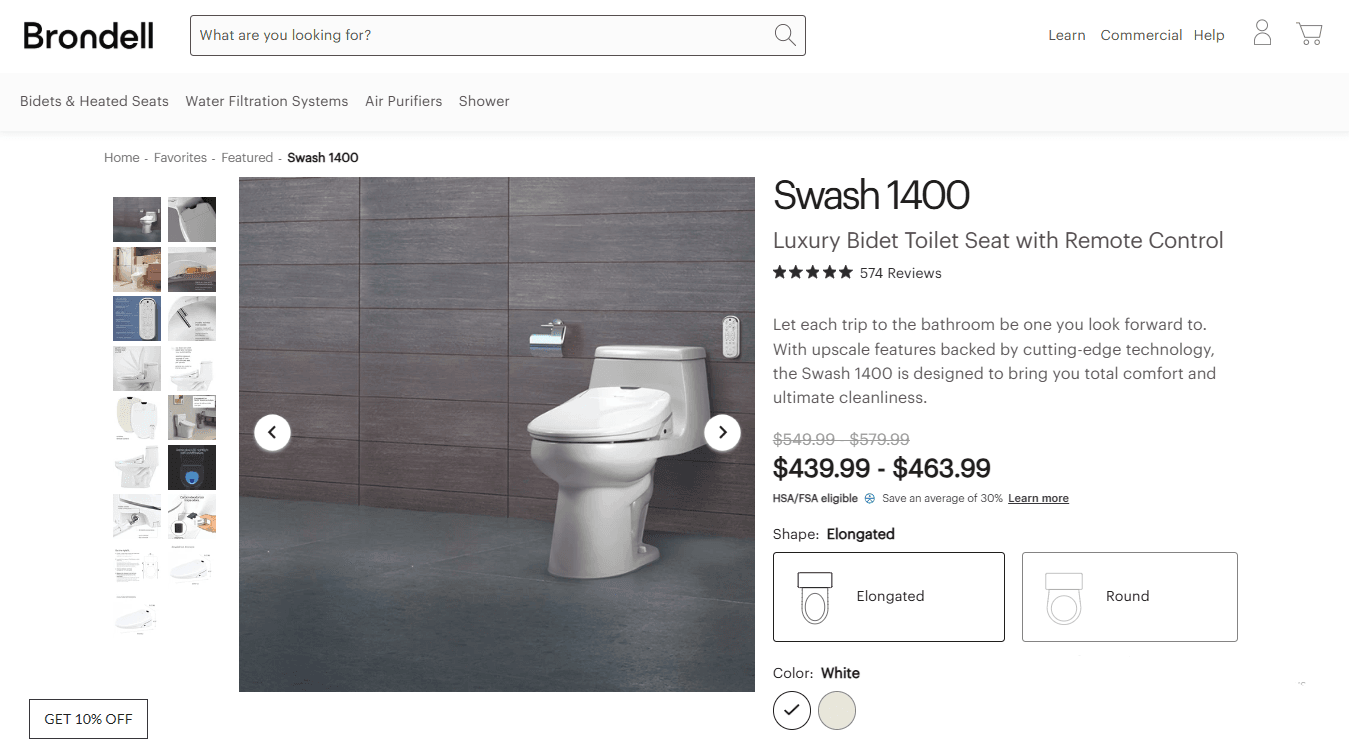
The team behind the Swash 1400 bidet seat on Brondell used OKRs to solve a very specific eCommerce problem: too many customers were reaching product pages but delaying purchases because they still had setup and compatibility concerns. Their objective was to reduce buyer hesitation during the decision stage.
The key results were tied directly to behaviors that affected conversion:
- Reduce installation-related pre-sales tickets
- Increase interaction with compatibility guides and feature comparison tools
- Improve checkout completion rate from returning product-page visitors
- Reduce the average time between the first product-page visit and purchase
What startups should learn is how Brondell avoided generic marketing goals. Their OKRs focused on removing friction at the exact stage where revenue was slowing down. Product content teams and UX teams all contributed to the same measurable outcome instead of operating under separate departmental priorities.
That is one of the clearest examples of OKRs working as an operational alignment system rather than a reporting framework.
2. Performance Lab
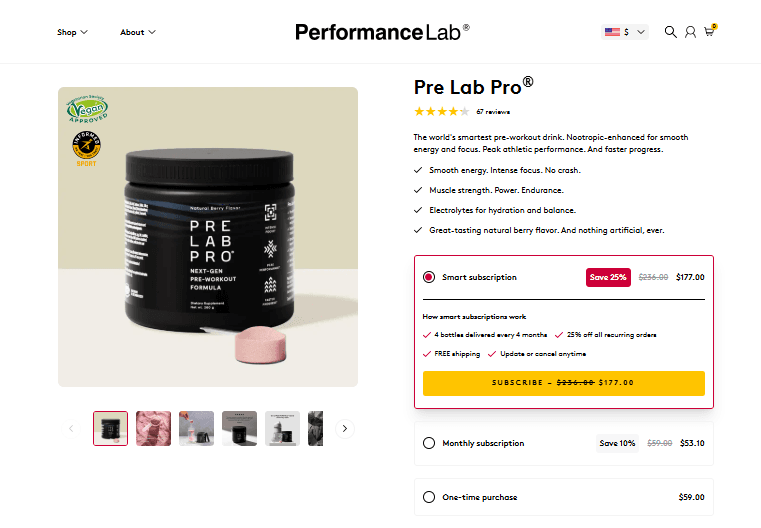
Pre Lab Pro from Performance Lab competes in a supplement category where many brands rely heavily on aggressive acquisition campaigns and short-term promotional spikes.
Performance Lab structured OKRs around customer retention quality instead of just top-of-funnel growth. Their objective focused on strengthening long-term customer trust in the product category.
The key results reflected that goal very clearly:
- Increase subscription renewal rate for repeat buyers
- Improve repeat purchase frequency among first-time customers
- Increase educational content engagement around ingredient transparency
- Reduce refund requests tied to expectation mismatch
The company used OKRs to protect brand positioning while scaling revenue. Every team worked toward improving customer confidence after purchase, not just acquisition before purchase. That distinction is important because many startups set growth objectives without attaching them to retention quality or customer satisfaction behavior.
3. Freeburg Law

The divorce attorney practice at Freeburg Law used OKRs to improve intake handling during emotionally sensitive legal situations where slow communication creates immediate trust loss. Their objective centered on improving client intake responsiveness and consultation readiness.
The supporting key results were highly operational:
- Reduce response time for new client inquiries
- Increase completed consultation bookings from intake forms
- Reduce incomplete intake submissions requiring follow-up clarification
- Improve preparedness rates before first attorney consultations
What startups can extract from this example is how measurable operational goals can directly improve trust in service-based businesses. Freeburg Law didn’t treat intake as basic admin work disconnected from growth.
Their OKRs connected client communication speed and consultation quality into one system with measurable benchmarks. That allowed the firm to improve client experience while also making internal legal workflows easier to manage at scale.
3 Best OKR Software For Startups To Improve Execution Visibility
Here are 3 effective OKR tools that do that well for startups.
1. OKRs Tool
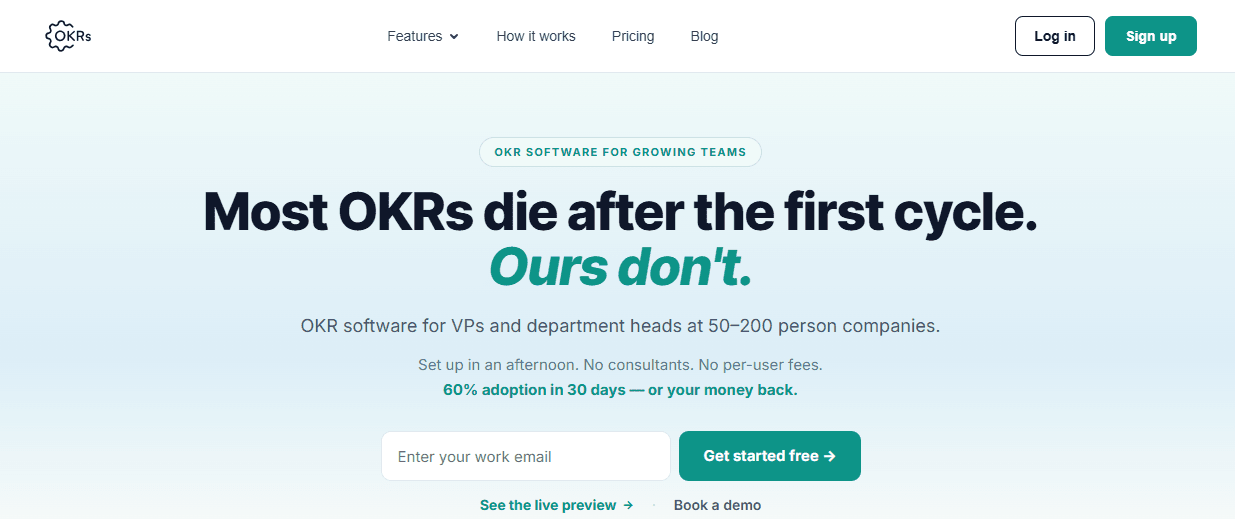
OKRs Tool is built for teams that want OKRs without turning it into a heavy setup project. It focuses on simple goal tracking, fast setup, and keeping execution visible without extra layers of the OKR process.
The key point here is straightforward: set objectives, track key results, and keep everything tied to actual progress instead of scattered updates. It also focuses heavily on flat pricing, which makes it easier for startups to scale without costs jumping per active user.
OKRs Tool Key Features
- Alignment Map: Teams can immediately see how their work contributes to broader business goals instead of operating inside disconnected dashboards.
- Automatic risk prediction for missed Key Results: The software analyzes progress velocity and flags objectives that are likely to miss targets before the quarter ends.
- Slack-based weekly check-ins: Teams can update progress directly from Slack without opening separate reporting workflows.
- AI-generated OKRs for fast startup onboarding: Founders can generate measurable objectives and key results quickly rather than spending hours writing them manually.
OKRs Tool Pricing
- Launch: Free (1–5 users)
- Scale: $49/month flat (6–50 users)
- Expand: $129/month flat (51+ users)
2. Tability
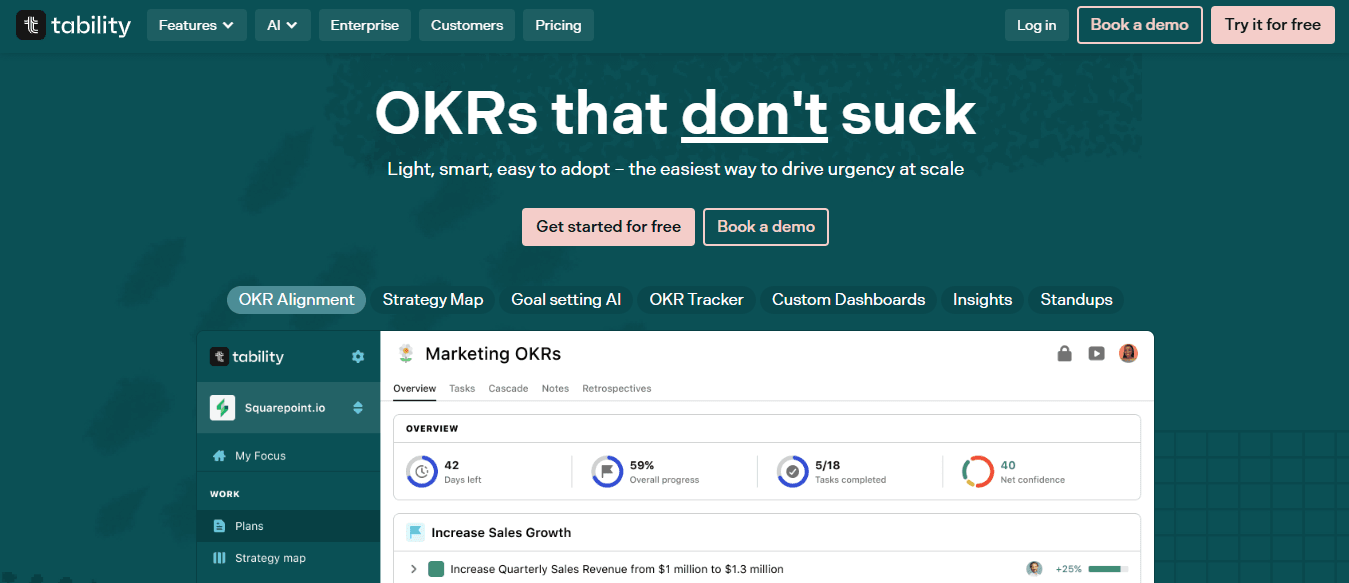
Tability is designed around keeping OKRs active through regular updates. Instead of treating OKRs as something you create and ignore after that, it keeps them visible through frequent updates and progress tracking.
Teams use it to stay aligned week by week, with a strong focus on turning company goals into ongoing conversations. It also connects well with modern team workflows and supports structured progress updates across goals. Where it stands out is its simplicity. It strips OKRs down into something teams can update quickly without deep training or complex configuration.
Tability Key Features
- AI-assisted goal creation: Teams can generate structured goals and measurable outcomes directly from rough ideas or broad objectives.
- Progress trend visualization: Tability shows movement patterns over time so teams can spot stalled execution early.
- Fast roundups directly from Slack: Employees can update goal progress in seconds without switching between multiple tools.
- Strategy Map for visibility across the entire organization: Leadership teams can connect and track OKRs across the company in one shared visual structure.
Tability Pricing
- Basic: $7/user/month
- Premium: $12/user/month
- Enterprise: Custom pricing
3. Weekdone
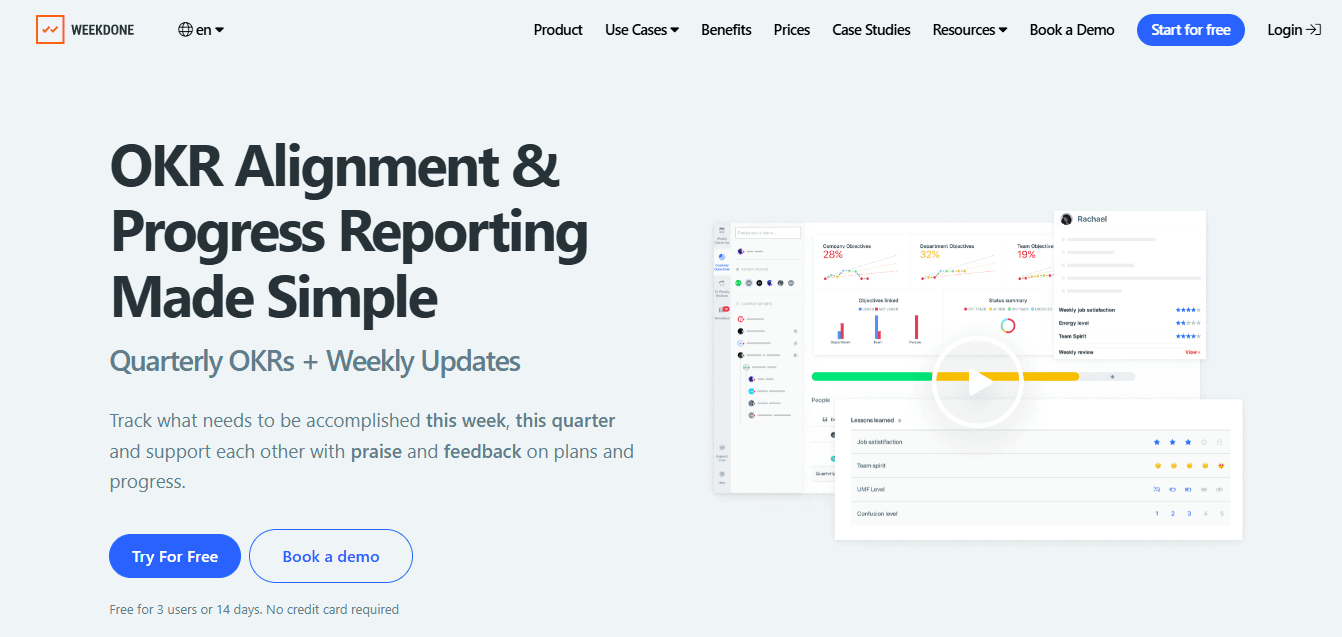
Weekdone combines OKR tracking with weekly planning in one system. It is built for teams that want a structured flow in how they report progress and set priorities. Instead of measuring success for long-term goals, it connects weekly execution with broader OKRs, which keeps day-to-day work tied to larger outcomes.
It also provides a visual hierarchy of goals, which makes it easier to see how work stacks across teams. It is more structured than lighter tools, with a strong emphasis on reporting cycles and visible progress updates across teams.
Weekdone Key Features
- Weekly PPP reporting system (Plans, Progress, Problems): Teams regularly share weekly execution updates tied directly to ongoing OKRs.
- Visual OKR hierarchy tree: Founders and managers can track how company-level goals connect to department and individual objectives.
- Integrated employee feedback and recognition tools: The platform includes kudos, feedback systems, pulse surveys, and 1:1 conversations alongside OKR tracking.
- Color-coded OKR tracking with KPI monitoring: Teams can monitor quarterly goals, KPIs, and execution status visually without having to go through spreadsheets.
Weekdone Pricing
- Free: Free for up to 3 users
- Paid plans: Custom pricing based on team size (Starting from $10.80/user/month)
Conclusion
The useful version of OKR for startups is simple. So keep it small enough that nobody has to “manage” it. One direction. A few outcomes. A short cycle. That is it. Avoid setting too many OKRs. If you find yourself adding more objectives or more metrics just to make it feel complete, it is already drifting away from what startups actually need.
At ShortDot, we help businesses create shorter and more memorable digital identities through domain extensions like .bond, .sbs, .cyou, .icu, .buzz, and .qpon. Instead of fighting for overcrowded traditional domains, your startup can build branded online experiences that actually stand out and stay easy to remember.
We also work with more than 400 global registrars and currently manage over 3 million domains worldwide. The focus has always been simple: make it easier for founders and growing businesses to build a stronger online presence without unnecessary complexity around branding and domain management.
Get started with ShortDot and build a brand people actually remember.
Author Bio:
Burkhard Berger is the founder of Novum™. He helps innovative B2B companies implement modern SEO strategies to scale their organic traffic to 1,000,000+ visitors per month. Curious about what your true traffic potential is?
- Author picture: Here
- Gravatar: vip@novumhq.com